
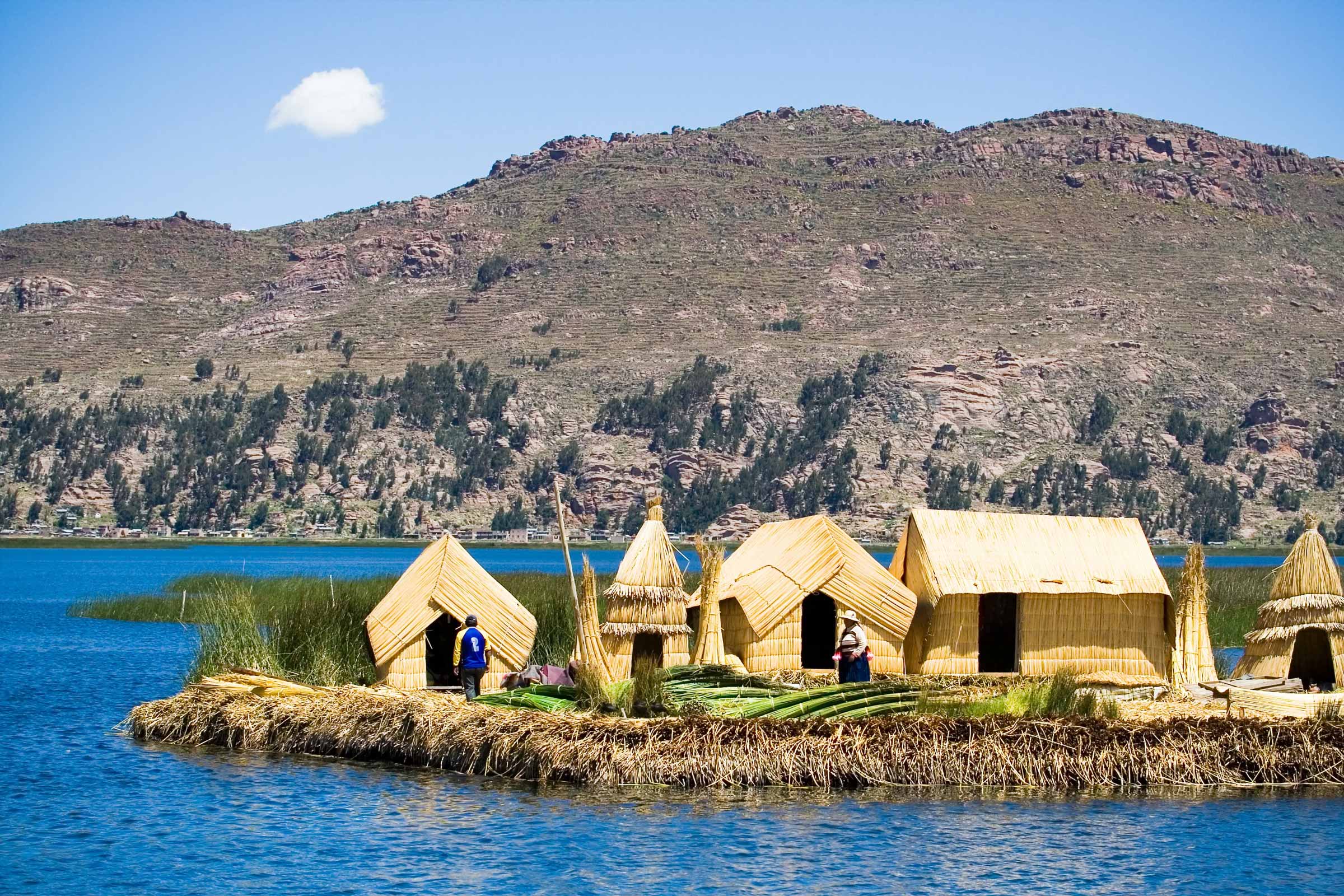
The Uros floating islands are man-made islands of totora reed on Lake Titicaca, about 20 minutes by boat from Puno according to PromPerú, where Uros families live on layers of reed that they keep renewing. Most visitors pair them with Taquile, a natural island whose textile art UNESCO inscribed in 2008 as Intangible Cultural Heritage, in a single full day. With two days, a night with a family on Amantaní completes the classic trio of islands on the Peruvian side of the lake.
- 3,810 m(12,500 ft): the altitude of Lake Titicaca, according to PromPerú.
- ≈20 minby boat from the port of Puno to the Uros islands (PromPerú).
- 2008the year UNESCO inscribed “Taquile and its textile art” on its Intangible Cultural Heritage list.
What the Uros floating islands are, and how they are built
The Uros islands are platforms of totora (Schoenoplectus tatora), a reed that grows in the lake. The base is a mat of reed roots, which floats; on top, families lay bundle after bundle of dry totora. Field studies summarized on Wikipedia describe that root layer, called khili, as about 1 to 2 m (3–7 ft) thick, with blocks tied together and moored with ropes to poles driven into the lakebed so the island does not drift. The top layers rot from below, so new reed goes on every few weeks or months, more often in the rainy season.
PromPerú notes that the same reed is used for the houses, boats and rafts, and also for medicine and food. Some islands are only about 20 m (66 ft) long. Their number changes over time and there is no official count: you will see figures from 40 to more than 100, none of them from a census.
Most Uros today speak Aymara and Spanish; the old Uru language has almost disappeared. Families combine bird hunting and egg collecting, which Andina describes as traditional activities of the Uros, with selling crafts to visitors. On a visit you land on one island, hear how it is built and see the houses and crafts.
Taquile: the weaving island, and what UNESCO actually recognized
Taquile is a natural island at 3,927 m (12,884 ft), according to PromPerú, and the reason most people make the longer trip. UNESCO proclaimed “Taquile and its textile art” in 2005 and inscribed it in 2008 on its Representative List of the Intangible Cultural Heritage of Humanity. That is living heritage, not a World Heritage Site: it protects a practice, not the island.
- Men and women weaveUNESCO notes that the textiles are made as an everyday activity by both men and women of all ages.
- The chullo and the calendar beltUNESCO highlights the chullo, a knitted hat with earflaps, and a wide woven waistband that depicts the year’s ritual and farming cycles.
- Old rootsAccording to UNESCO, the tradition goes back to the Inca, Pukara and Colla cultures, and the cloth is still woven on pre-Hispanic ground looms with four stakes.
UN Tourism also named Taquile one of its Best Tourism Villages in 2023. Expect a walk: on our kayak tour, the boat lands on the north side and the walk up to the main square, with stops, takes about an hour and a half. If a steep climb at this altitude is a concern, the Taquile, Luquina and Uros tour by speedboat, from US$75, lands on the south side to avoid the long walk to the square.
Amantaní and Luquina: staying with a family
Amantaní is a natural island about 3 h 30 min by boat from Puno, according to PromPerú. On our tours, visitors split into small groups and stay with local families, eat what the family cooks and sleep in rustic rooms. In the late afternoon, a walk of about an hour climbs to the Pachamama and Pachatata temples on the island’s two hills, at up to about 4,150 m (13,615 ft); on our kayak tour it is timed for sunset. Pack warm layers for the evening.
Luquina Chico is not an island but an Aymara community on the Chucuito Peninsula that also hosts visitors in family homes. On our speedboat day it is the lunch stop, with a buffet of local produce by the water.
The Titicaca National Reserve around the islands
Much of the Uros archipelago lies within the Titicaca National Reserve, a protected area managed by SERNANP, Peru’s national protected-areas service. According to the state news agency Andina, it was created on October 31, 1978, by Supreme Decree 185-78-AA and covers 36,180 ha (about 89,400 acres) in two sectors with no physical link: Puno, with 29,150 ha between Esteves Island and the Capachica Peninsula, and Ramis, with 7,030 ha in Huancané province.
| Titicaca National Reserve | Figure |
|---|---|
| Created | October 31, 1978 (Supreme Decree 185-78-AA) |
| Area | 36,180 ha: Puno sector 29,150 ha, Ramis sector 7,030 ha |
| Totora reed beds | About 27,600 ha |
| Wildlife recorded | 159 species of fauna, including 105 birds and more than 26 fish |
| Endemic species | Titicaca grebe (Rollandia microptera) and Titicaca water frog (Telmatobius culeus) |
| Ramsar wetland | The whole Peruvian side of the lake, since January 20, 1997 |
Source: Andina, report on the reserve’s 40th anniversary (November 6, 2018), with data from SERNANP.
The reed beds you cross on the way to the Uros are the habitat of the grebe and other water birds, so watch for them from the boat.
How long the boat rides take from Puno
Boats leave from the port of Puno. Times depend on the boat (our day tours use speedboats; conventional launches are slower) and on the wind. These are the times on our itineraries and from PromPerú:
| Leg | Approximate time | Source |
|---|---|---|
| Puno → Uros | ≈20 min | PromPerú |
| Uros → Taquile | ≈2 h | Our Uros–Taquile full day (speedboat) |
| Uros → Amantaní | ≈3 h | Our Lake Titicaca 2D/1N |
| Puno → Amantaní (direct) | ≈3 h 30 min | PromPerú |
| Amantaní → Taquile | ≈1 h | Our kayak tour schedule (8:00 → 9:00 a.m.) |
| Taquile → Puno | Leaves ≈1:30 p.m., back in Puno ≈4:00 p.m. | Our kayak tour schedule |
| Esteves Island → Uros by kayak | ≈1 h paddling | Our kayak tour |
Approximate times; they vary with the boat and the weather.
How much time to give the islands: half day, full day or two days
It depends on what you want to see. Only the Uros fits in a morning or an afternoon, since the islands are so close to Puno; we don’t run that short trip, and our shortest lake option is a full day. Uros and Taquile take a full day, starting early. A night on Amantaní adds the homestay and puts Taquile on the morning of day two.
| Time | What you see | Best for | With us |
|---|---|---|---|
| Half day | One Uros island | Travelers with a single free morning or afternoon in Puno | We don’t offer it |
| Full day | Uros, then Taquile with lunch on the island | Most visitors: the weaving island and the reed islands in one day | Uros–Taquile full day, from US$80 (hotel pickup 6:45 a.m.) |
| Full day, south route | South side of Taquile, lunch in Luquina Chico, Uros | Less walking on Taquile, buffet lunch on the shore | Taquile, Luquina and Uros by speedboat, from US$75 |
| 2 days / 1 night | Uros, a night with a family on Amantaní, Taquile on day 2 | Slower travel, sunset from the temples, time with a local family | Lake Titicaca 2D/1N, from US$120, built around the overnight bus from Cusco |
| With a paddle | Kayak to the Uros, then motorboat to Amantaní and Taquile | Active travelers; no kayaking experience needed | Kayak tour: Uros, Amantaní, Taquile, from US$95; check the itinerary for the schedule |
Prices per person from our tour pages; island entrances are included on all four. Compare them with our land tours on all our Puno and Lake Titicaca tours.
Our lake tours pick you up between 6:45 and 8:00 a.m., so keep them for the day after you arrive. With a second day in Puno, Sillustani and Inca Uyo in Chucuito make a good land day; our guide to Puno’s “Fertility Temple” without the myths explains what that site really is.
Entrance fees, cash and visiting responsibly
The Uros, Taquile and Amantaní each charge visitors an entrance fee, collected in cash in soles by the communities. We could not find an official, dated list of the amounts, and they change, so we don’t quote a figure: if you go on your own, carry small notes. On our four lake tours the island entrances are already included.
- PhotosThe islands are people’s homes. Ask before you photograph someone up close, and accept a no. On the Uros, walk where your hosts show you: the reed surface is soft and uneven.
- ShoppingOn Taquile, UNESCO notes that the communal economy rests mainly on textiles and tourism, and that rising demand has also changed materials and production, so ask who made a piece and where. Buying directly from the families you meet keeps the money on the islands.
- Reed-boat ridesOn the Uros, families offer short rides on reed boats. On our speedboat tour this ride is optional and costs S/10–15, according to its tour page.
- TipsTips for the boat crew and the guide are not included on our lake tours. Our Inca Trail tipping guide also explains how tipping works in Peru.
- RubbishMuch of the lake around the islands is a protected reserve: bring your bottles and wrappers back to Puno.
Weather, the best time to go, and the altitude
Puno is cool all year. SENAMHI, Peru’s weather service, records daytime highs of about 15–18 °C (59–64 °F) in every month in its 1991–2020 normals for Puno, while the nights change a lot: from about 6 °C (43 °F) in the wet season to just below freezing in June and July. May to September is the dry season, with almost no rain from May to August; December to March brings most of the year’s rain.
| Season | Months | Rain per month | Average high / low |
|---|---|---|---|
| Wet | December–March | ≈88–159 mm | ≈16–17 °C / 5.5–6 °C |
| Shoulder | April, October, November | ≈40–51 mm | ≈16–18 °C / 4–5 °C |
| Dry | May–September | ≈3–24 mm | ≈15–17 °C / −1 to 2 °C |
SENAMHI climate normals for Puno, 1991–2020. The water stays cold all year: dress for wind on the boat, not for the temperature on land.
Bring layers, a windproof jacket, sunscreen and sunglasses in any season. The lake is at 3,810 m, and Puno sits at roughly 3,800–3,830 m, higher than Cusco, so plan an easy arrival day and ask your doctor about altitude before the trip. Our guide to altitude sickness and what the CDC says covers symptoms and acclimatization, and how high every stop of a Peru trip is compares Puno with Cusco and Machu Picchu. Arriving from Cusco after a few days there is the gentler way up; flying in from the US, start with our Lima to Cusco guide.
Frequently asked questions
What are the Uros floating islands made of?
How long is the boat ride from Puno to the Uros islands?
Are the Uros islands worth it?
Is Taquile a UNESCO World Heritage Site?
How much is the entrance fee to the Uros and Taquile?
Can you stay overnight on the islands?
When is the best time to visit Lake Titicaca’s islands?
Are Copacabana and the Island of the Sun part of these trips?
About the author
Raquel Sánchez co-founded Terra Quechua Peru in Cusco in 2012 together with Edwin Medina, both with extensive trekking experience. She writes our Inca Trail guides from the day-to-day work of securing permits and organizing every departure with our guides, cooks and porters.