
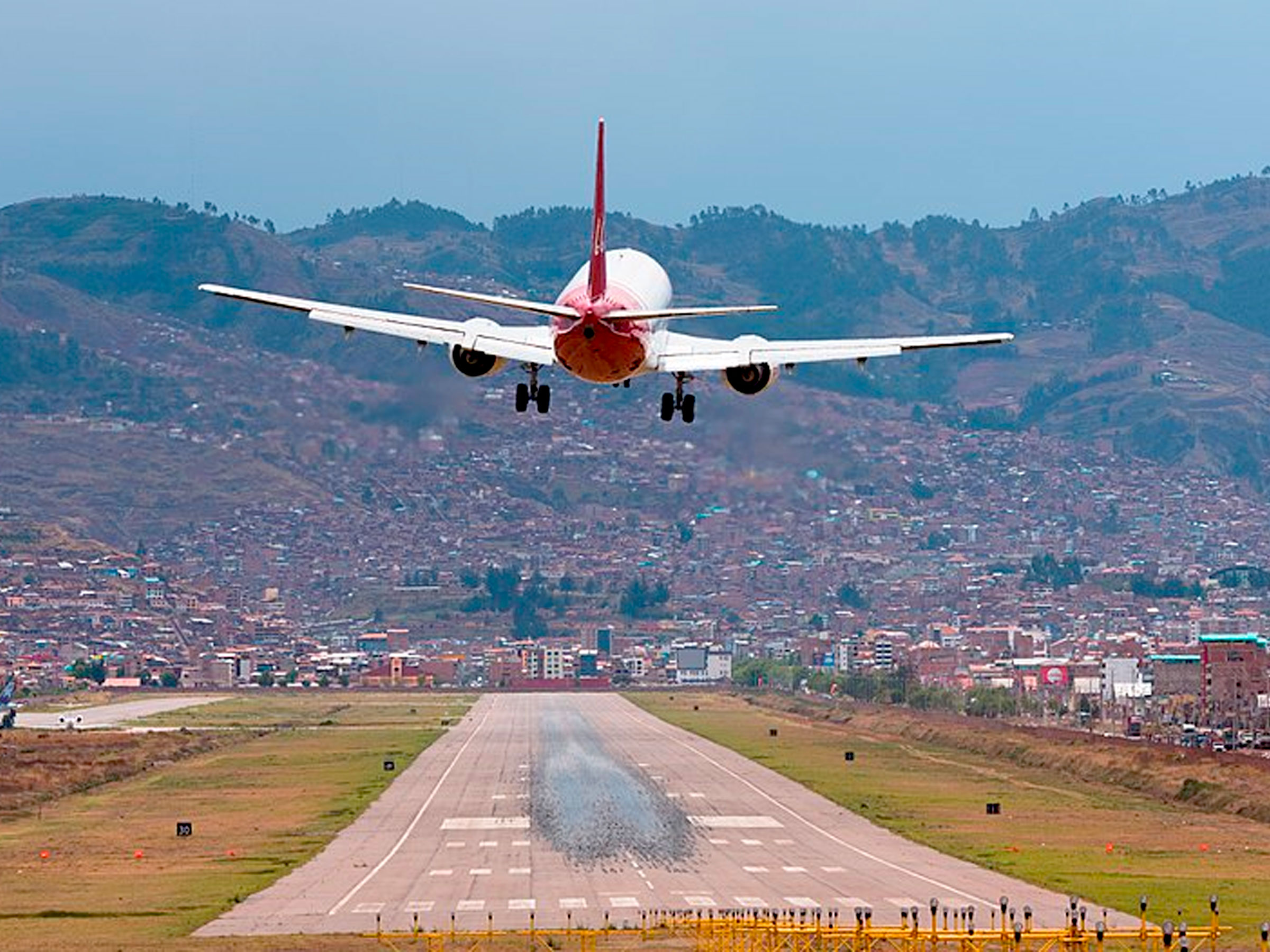
The fastest way to get from Lima to Cusco is a nonstop flight of about 1 hour 20 minutes, flown many times a day by LATAM, Sky Airline and JetSMART. The bus takes 20 to 25 hours across the Andes, which is why almost every visitor flies. Either way you go from sea level to about 3,400 m (11,150 ft) in one day, so the best plan is a morning flight and a first night lower down, in the Sacred Valley.
- ≈1 h 23 minaverage nonstop flight time from Lima (LIM) to Cusco (CUZ).
- 20–25 hby bus, depending on the company and the route.
- 3,400 m(11,150 ft): the altitude of Cusco, coming straight from the coast.
Flying from Lima to Cusco: flight time, airlines and airports
According to Kayak’s route data, checked on October 15, 2026, the nonstop flight from Lima to Cusco averages 1 hour 23 minutes, with scheduled times between about 1 h 20 min and 1 h 35 min for a distance of 364 miles (586 km). Three airlines fly it nonstop: LATAM (about 160 flights a week), Sky Airline (about 49) and JetSMART (about 30). That adds up to roughly 33–35 departures a day, the first one before dawn.
It is one of the busiest air routes in South America: in its 2025 results, LATAM listed Cusco–Lima first among the routes with the most daily flights in its whole network, as Forbes reported in January 2026. Schedules change with the season, so always check the airlines’ own websites before you book.
- Lima: Jorge Chávez International (LIM)The new passenger terminal opened in June 2025, and domestic and international flights now operate from the same building. The airport operator, Lima Airport Partners, reports 23 airlines connecting Lima with 68 destinations after its first year.
- Cusco: Alejandro Velasco Astete International (CUZ)Run by the state company CORPAC, it sits about 3.7 km (2.3 mi) from the historic center, at 3,310 m (10,860 ft). It has a single runway with high ground on three sides, and landings are made from one direction only.
- Chinchero: not open yetAccording to Peru’s Ministry of Transport (MTC), quoted by the state news agency Andina on January 15, 2026, the new Chinchero International Airport was about 40% built and should start operating in late 2027 or early 2028. For now, every flight lands at Velasco Astete.
Lima to Cusco by bus: route, companies and comfort
There is no passenger train between Lima and Cusco, so the overland option is the bus. On October 14, 2026, the booking site CheckMyBus listed Lima–Cusco departures with Cruz del Sur, Civa, Oltursa, Palomino and other companies, with journey times of 20 to 25 hours; most leave Lima between late morning and late afternoon and reach Cusco the next day. The same page showed fares from about US$30 to US$77, depending on the company and the seat.
The direct route follows the coast south and then crosses the Andes via Abancay: it is the shortest, but the mountain section is long, winding and sensitive to the weather. The other option goes through Arequipa and Puno and only makes sense as a trip of several days with stops.
- SeatsSemi-cama seats recline to about 140° and cama seats to about 160°; some services offer 180° beds (How to Peru, updated January 2026). On a ride of more than 20 hours, the extra recline is worth paying for.
- TerminalsEach company uses its own terminal in Lima and in Cusco. Check the address on your ticket and allow time for Lima traffic.
- Road conditionsSUTRAN, Peru’s land transport regulator, reports incidents and road closures. Check it the day before, especially in the rainy season.
Plane vs bus: why almost everyone flies
The numbers decide it. The flight is under an hour and a half in the air; even with check-in and transfers, it takes half a day. The bus takes a full day and a night each way, which is two days of a vacation gone on the round trip. And arriving by bus does not help with the altitude: you still end up at 3,400 m, only after a night of poor sleep on the road.
The bus makes sense if you are already traveling overland through southern Peru with plenty of time, for example combining Arequipa and the Colca Canyon before Cusco. If you are coming from the United States for a trek on fixed dates, fly.
| Plane | Bus | |
|---|---|---|
| Travel time | ≈1 h 20 min–1 h 35 min nonstop | 20–25 h |
| Departures | About 33–35 a day, from before dawn | A few a day per company, mostly from late morning to afternoon |
| Companies | LATAM, Sky Airline, JetSMART | Cruz del Sur, Civa, Oltursa, Palomino and others |
| Where you arrive | Cusco airport, 3.7 km from the center | The bus company’s terminal in Cusco |
| Fares | Vary by date and fare type: check the airlines | About US$30–77 (CheckMyBus, October 14, 2026) |
| Altitude | Sea level to 3,400 m in under 2 hours | Same arrival altitude, after a night on the road |
| Best for | Trips with fixed dates, such as an Inca Trail trek | Long overland trips through southern Peru |
Flight data from Kayak (checked October 15, 2026); bus data from CheckMyBus listings for October 14–21, 2026. Schedules and fares change: confirm with each company before you book.
Connecting from the US: how much time to leave in Lima
There are no nonstop flights from the United States to Cusco, so you connect in Lima. Passport rules, US departure cities, time zones and a full itinerary are in our guide to planning the Inca Trail from the USA. Here we cover only the connection itself.
- You enter Peru in LimaOn an international-to-domestic connection you go through immigration in Lima, collect your bags, check in again for Cusco on the departures level and pass security from scratch, even in the new terminal.
- 3 hours or moreAccording to the airport guide Layover Index (reviewed June 2026), the airport recommended a minimum of 3 hours for this kind of connection during the new terminal’s first year.
- Landing late at night?Sleep near the airport and take a morning flight to Cusco the next day. Missing a connection should not cost you an acclimatization day.
- One ticket or twoIf the Lima–Cusco flight is on the same booking as your international flight, the airline handles a missed connection. On separate tickets, a delay on the first flight is usually your problem, so leave even more time.
Why we recommend a morning flight
Cusco’s airport sits in a valley with mountains on three sides and a single landing direction, so low cloud and wind can delay flights or force them to turn back. From our experience as a Cusco operator, these delays are more frequent later in the day and in the rainy season. A morning flight has two advantages: you are more likely to land on time, and if your flight is cancelled, there are still many flights left that day to rebook on.
The same logic applies on the way home. Book your Cusco–Lima flight for the day after the trek, never the same evening: on the Classic route you get back to Cusco after dark. Our guide to getting back from Machu Picchu explains the timing.
Luggage: the flight, then the train
On the Lima–Cusco route, the cheapest fares on all three airlines are built around a small personal item that fits under the seat; a cabin bag and a checked bag usually cost extra or come with a higher fare. Check what your fare includes before you pack, especially if the domestic flight is on a separate ticket, because its allowance can be smaller than on your international flight.
The tighter limit comes later. PeruRail allows one backpack of up to 8 kg and 100 cm (height + length + width) per passenger on its Machu Picchu trains, so on the trek you travel light and leave your suitcase at your hotel in Cusco or at our office. Our Inca Trail packing list is built around that limit.
Arriving at 3,400 m: why to start in the Sacred Valley
The flight takes you from the coast to Cusco in under two hours, with no time to adjust. The CDC lists Cusco among the destinations above 2,500 m (8,200 ft) where travelers are at risk of altitude illness. Its altitude guidance adds that in Cusco travelers can go down to sleep lower than the airport for one or two nights before going higher, which may avoid the need for medication, and that you should skip alcohol and heavy exercise for the first 48 hours. Ask your doctor before the trip. Symptoms, sleeping altitudes on the trail and a 3-day plan are in our guide to altitude sickness on the Inca Trail.
| Place | Altitude | Drive from Cusco |
|---|---|---|
| Cusco (city) | 3,400 m / 11,155 ft | — |
| Cusco airport | 3,310 m / 10,860 ft | ≈3.7 km from the center |
| Urubamba | 2,871 m / 9,419 ft | ≈1 h 25 min via Chinchero |
| Ollantaytambo | 2,792 m / 9,160 ft | ≈1 h 55 min via Chinchero and Urubamba |
Town altitudes and drive times (without stops) from our Sacred Valley route map; airport altitude from public aviation data.
In practice: from the airport, go straight down to Urubamba or Ollantaytambo, take it easy on the first afternoon and spend the next day visiting the valley at a gentle pace. Our Sacred Valley guide has the map, the sites and the tourist ticket, and our Sacred Valley full-day tour or the Sacred Valley tour with the Machu Picchu connection fit those first days. Then move up to Cusco for the trek briefing at our office at 6 p.m. the evening before you start.
Plan your Lima–Cusco leg in five steps
- Book the trek firstInca Trail permits are the scarce part; flights can be booked once your dates are confirmed. Use the same passport for the permit and the flights.
- Fly to Cusco in the morningIf your US flight lands late in Lima, sleep there and take an early flight the next day.
- Check your baggage allowanceLook at what your domestic fare includes, and pack for the 8 kg train limit on the trek.
- Sleep lower on the first nightsHead to the Sacred Valley, then move up to Cusco before the trek.
- Fly home the day after the trekNever on the last evening of the Inca Trail.
Short on days after the flights? The Short Inca Trail in 2 days, from US$520 for 2026 departures (US$560 from January 2027), never goes above 2,720 m and ends with a hotel night in Aguas Calientes. If you would rather skip the trek, our Machu Picchu day trip by train runs from Cusco, from US$295.
Frequently asked questions
How long is the flight from Lima to Cusco?
Which airlines fly from Lima to Cusco?
How long is the bus from Lima to Cusco?
Is there a train from Lima to Cusco?
How much time do I need in Lima between an international flight and the flight to Cusco?
Is the new Chinchero airport open?
Should I sleep in Cusco or the Sacred Valley after landing?

About the author
Raquel Sánchez co-founded Terra Quechua Peru in Cusco in 2012 together with Edwin Medina, both with extensive trekking experience. She writes our Inca Trail guides from the day-to-day work of securing permits and organizing every departure with our guides, cooks and porters.