
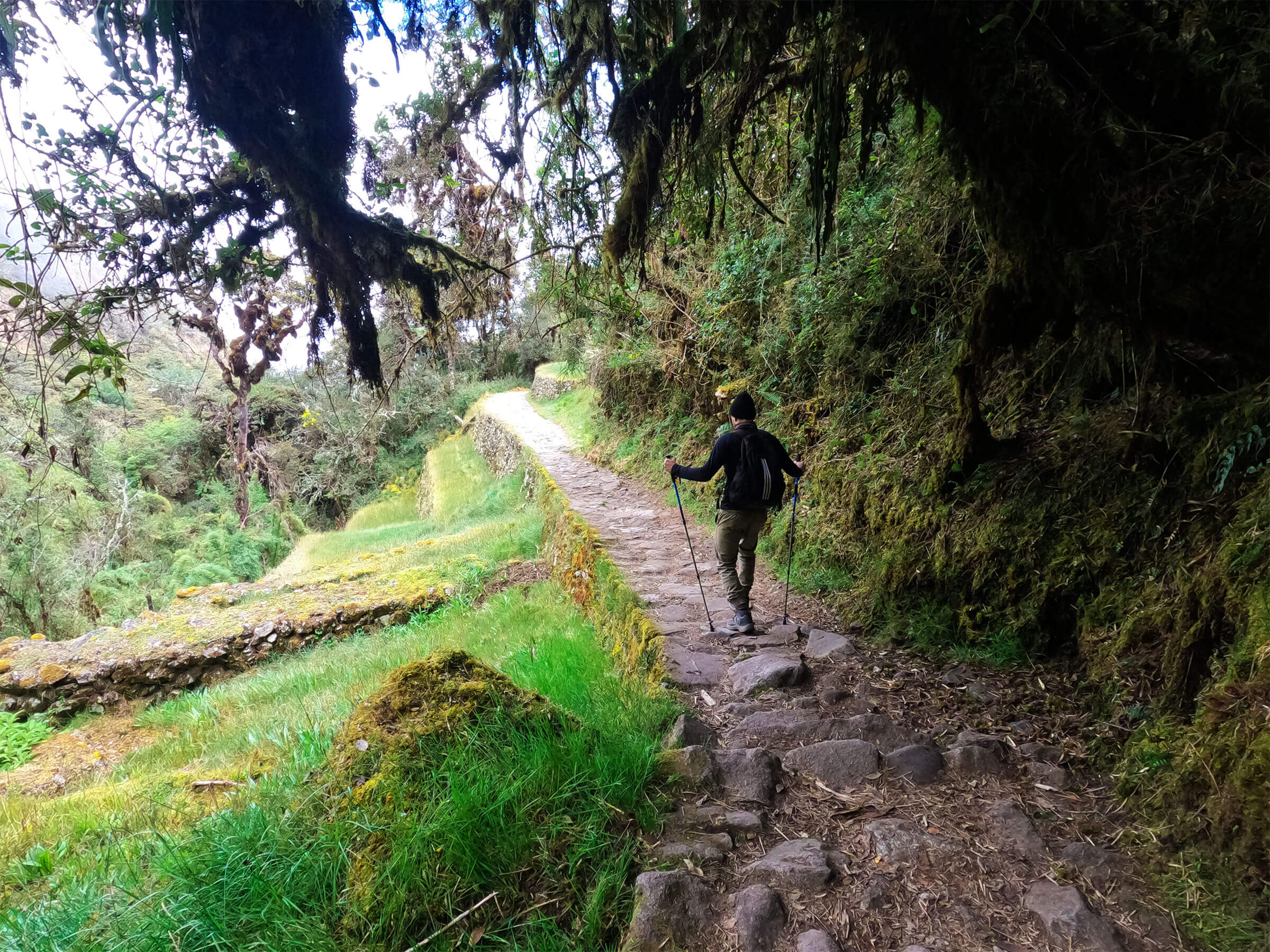
To train for the Inca Trail, give yourself about 12 weeks: three or four short sessions during the week and one long hike at the weekend, building up to 5–6 hours with about 1,000–1,200 m (3,300–4,000 ft) of climbing, followed by a second hiking day. That is what day 2 and day 3 of the Classic trek ask of you. This plan is built on the trail’s real numbers, works even if you live somewhere flat, and comes as a free printable PDF to tick off week by week.
- +1,215 m(3,990 ft) of climbing on day 2, up to Dead Woman’s Pass.
- −1,400 m(4,590 ft) of descent on day 3, mostly on Inca stairs.
- 12 weeksfrom your first walk to the plane, with two easier weeks built in.
What you are training for: the trail in numbers
Most training advice says “walk a lot and climb some hills”. It helps more to know exactly what each day asks of your legs. These are the figures from our trail profile for the Classic Inca Trail in 4 days and the 2-day route:
| Day | Distance | Up / down | Walking time |
|---|---|---|---|
| Classic, day 1: Km 82 → Wayllabamba | 12 km (7.5 mi) | +400 m / −100 m (+1,310 / −330 ft) | 6–7 h |
| Classic, day 2: over Dead Woman’s Pass (4,215 m) to Pacaymayo | 11 km (6.8 mi) | +1,215 m / −615 m (+3,990 / −2,020 ft) | 7–8 h |
| Classic, day 3: Pacaymayo → Wiñay Wayna | 13.5 km (8.4 mi) | +450 m / −1,400 m (+1,480 / −4,590 ft) | 7–8 h |
| Classic, day 4: Sun Gate → Machu Picchu | 5.5 km (3.4 mi) | +100 m / −320 m (+330 / −1,050 ft) | 2–3 h |
| 2-day route, day 1: Km 104 → Machu Picchu | 11.5 km (7.1 mi) | +650 m / −320 m (+2,130 / −1,050 ft) | 6–7 h |
Approximate figures from our trail profile; times include breaks and visits to the Inca sites. See every day in detail in the Classic Inca Trail day by day.
Two things stand out. Day 2 is one long climb at altitude, and day 3 is the longest day, with a huge descent on uneven stone steps, some of them knee-high. The distances are modest; the climbing, the stairs and doing it day after day are what you train for. That is why this plan uses back-to-back weekend hikes and trains the descent, not only the climb.
Before week 1: what training can and can’t do
- Fitness does not prevent altitude sickness. The CDC is clear that training and physical fitness do not change your risk of altitude illness. What protects you is time: two or three days in Cusco or the Sacred Valley before the trek. Read our guide to altitude sickness on the Inca Trail.
- Fitness makes the trail enjoyable. At 4,000 m everyone is short of breath. A trained body has more in reserve, recovers overnight and keeps the knees safe on the way down.
- Start from the US baseline. The Physical Activity Guidelines for Americans recommend 150–300 minutes of moderate activity a week plus muscle-strengthening on 2 days. If you are not there yet, spend 2–4 weeks building up to it before week 1.
- See your doctor first if you have heart, lung or joint conditions, or have been inactive for a long time.
The 12-week Inca Trail training plan
Weekday sessions are 30–55 minutes of brisk walking uphill, stairs, an inclined treadmill, cycling or swimming, plus two short strength sessions. The weekend hike is the key session. Weeks 4 and 8 are easier on purpose: that is when your body adapts.
| Week | Weekdays | Weekend hike | Daypack |
|---|---|---|---|
| 1 | 3 brisk walks of 30 min, one on hills · 2 strength sessions of 20 min | 1.5 h, 150–300 m (500–1,000 ft) of climbing | Empty |
| 2 | 3 × 35 min · 2 strength | 2 h, 300 m (1,000 ft) | 2 kg (4 lb) |
| 3 | 3 × 40 min, one on stairs · 2 strength | 2.5 h, 400 m (1,300 ft) | 3 kg (7 lb) |
| 4 · easier | 3 easy × 30 min · 1 strength | 2 h, easy terrain | 3 kg (7 lb) |
| 5 | 3 × 45 min, one with 20 min of stairs · 2 strength | 3 h, 500 m (1,650 ft) | 4 kg (9 lb) |
| 6 | 3 × 45 min, 25 min of stairs up and down · 2 strength | 3.5 h, 600 m (2,000 ft) | 4 kg (9 lb) |
| 7 | 3 × 50 min, 30 min of stairs · 2 strength | Sat 3.5 h + Sun 2 h: your first back-to-back weekend | 5 kg (11 lb) |
| 8 · easier | 3 easy × 40 min · 1 strength | 2.5 h | 4 kg (9 lb) |
| 9 | 3 × 50 min, 35 min of stairs · 2 strength | Sat 4–5 h, 800 m (2,600 ft) + Sun 2–3 h | 5 kg (11 lb) |
| 10 | 3 × 55 min, 40 min of stairs · 2 strength | Sat 5–6 h, 1,000 m (3,300 ft) + Sun 3 h with long descents | 5–6 kg (11–13 lb) |
| 11 · peak | 3 × 50 min · 1 strength | Sat 5–6 h, 1,000–1,200 m (3,300–4,000 ft) + Sun 4 h, mostly downhill | 5–6 kg, full trail kit |
| 12 · taper | 2–3 easy walks of 30–40 min | 1.5 h easy, or travel to Cusco | Light |
Why 5–6 kg? On our Classic trek, porters carry up to 5 kg of your things (sleeping bag and clothes). You carry a daypack with about 2 liters of water (2 kg / 4.4 lb), rain gear, a warm layer and snacks. On the 2-day route there are no porters, so train with the pack you will really carry.
Train the descent: day 3 is the knee test
Many hikers prepare for the climb to Dead Woman’s Pass and are surprised by day 3. Going down 1,400 m on irregular stone steps works the front of your thighs in a different way, braking with every step, and that is what makes legs shake and knees complain. Three habits fix most of it:
- Walk down, on purpose. From week 6, add stairs down to your stair sessions, and choose weekend routes with long descents. In a building, take the elevator up and walk down.
- Slow step-downs in your strength sessions: stand on a step and lower the other heel to the floor in three seconds.
- Train with poles. They take load off the knees on the way down. On the Inca Trail they must have rubber tips; bring yours or rent a pair from us.
If you live somewhere flat
No hills near home, in Florida, Texas or the Midwest? You can still train the climbing:
- Inclined treadmill: at a 15% incline and 3 km/h (1.9 mph) you climb about 450 m (1,480 ft) per hour. Two 40–60 minute sessions a week cover the weekday climbing.
- Stairs and stair machines: day 2’s 1,215 m is roughly 400 floors, counting about 3 m (10 ft) per floor. Office buildings, parking garages and stadium stairs all work, and they also let you train the descent.
- Long weekend walks with your pack still matter: time on your feet and getting used to your boots cannot be done on a machine.
- One test trip with real hills around weeks 9–11, if you can: a weekend in the nearest hilly state park is the best rehearsal.
Strength in 20 minutes, twice a week
Two rounds of 10–12 repetitions of each exercise, no gym needed: step-ups on a stair or bench, reverse lunges, slow step-downs, calf raises, glute bridges and a plank of 30–45 seconds. Add weight in a backpack when they feel easy. Strong legs and a strong core make the stairs, and your daypack, feel lighter.
Benchmarks: are you ready?
At the end of week 11 you should be able to say yes to all three:
- The long dayHike 5–6 hours with 1,000 m (3,300 ft) or more of climbing, carrying 5–6 kg, at a pace where you can still talk.
- The day afterWalk again the next day for 3–4 hours, including long descents, without knee pain.
- The kitYour boots, socks, daypack, poles and water system have done at least three long hikes without blisters or surprises.
Not quite there? You can still do the trek. Our guides set a steady pace and the group regroups at the top of each climb. Tell us when you book, and read our honest guide to how hard the Inca Trail is.
The last two weeks and your days in Cusco
- Week 12 is a taper: keep moving but cut the volume, sleep well and don’t try a last big hike.
- Arrive 2–3 days before the trek. Use them for an easy city tour or the Sacred Valley, not for a 5,000 m rainbow mountain.
- Pack with the list: our Inca Trail packing list has its own printable checklist.
Starting late, or doing the 2-day trail
- Only 6 weeks? Do the plan’s weeks 2, 3, 5, 6 and 10, then taper. Prioritize the weekend hike and the stairs.
- The 2-day Inca Trail is one 6–7 hour day with about 650 m (2,130 ft) of climbing, and you carry your own pack. Weeks 1–8 of this plan plus the taper are enough for most people. Not sure which route suits you? Read 2-day vs 4-day Inca Trail.
- Over 60? See our guide to hiking the Inca Trail at 60, 70 or 80, with the route that fits each fitness level.
Frequently asked questions
How long should I train for the Inca Trail?
How fit do you need to be for the Inca Trail?
Can I train for the altitude at home?
What is the hardest part of the Inca Trail to train for?
How do I train for the Inca Trail if I live somewhere flat?
Do I need to train for the 2-day Inca Trail?
About the author
Raquel Sánchez co-founded Terra Quechua Peru in Cusco in 2012 together with Edwin Medina, both with extensive trekking experience. She writes our Inca Trail guides from the day-to-day work of securing permits and organizing every departure with our guides, cooks and porters.