
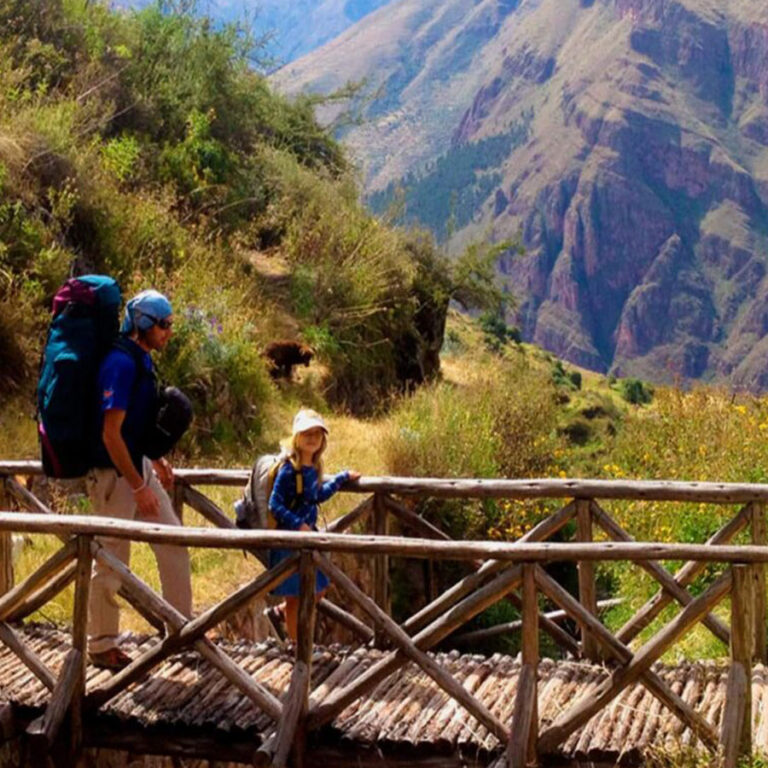
 4.7 2 Days

Huchuy Qosqo
Huchuy Qosqo Hike: The Inca “Little Cusco” Above the Sacred Valley
Huchuy Qosqo is located on the plateau of a mountain. This place offers impressive views of the Pitusiray snow-capped mountains and the town of Calca. It is believed that this place was built by order of the Inca Wiracocha for him to rest in his old age, but it is also believed that it was built to observe lightning and thunder crashing into the ground
Huchuy Qosqo is an Inca estate on a plateau above the Sacred Valley that you can only reach on foot. Below are our two treks to the ruins, followed by a local operator’s guide to the routes, altitude, entrance fee and the way back from Lamay.
4.7 2 Days 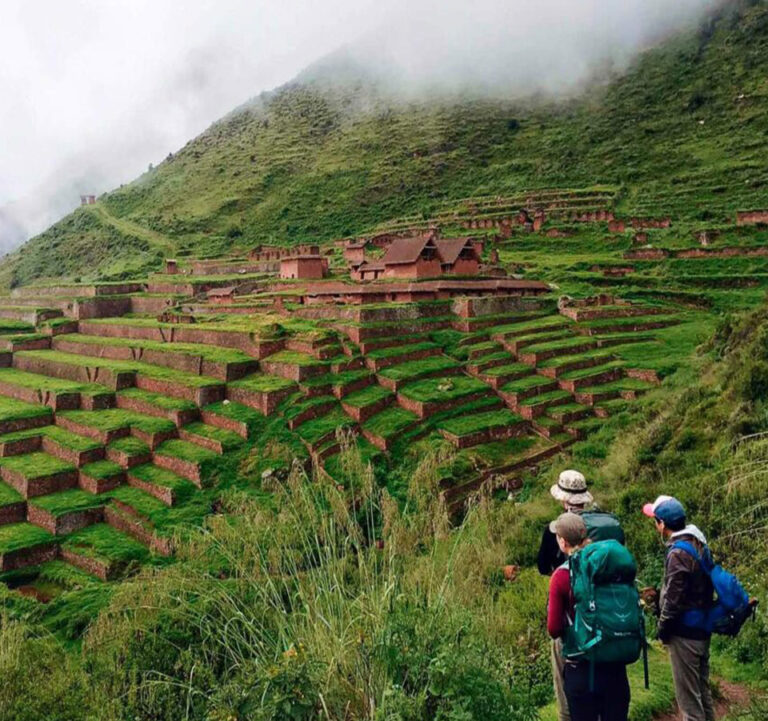 4.7 3 Days
Huchuy Qosqo (“little Cusco” in Quechua) is an Inca royal estate on a plateau above the Sacred Valley, at about 3,600–3,650 m (11,800–11,975 ft): our itineraries and several guides give 3,600 m, while Wikipedia and others give 3,650 m. No road reaches the ruins, so the only way in is the Huchuy Qosqo hike, either a short, steep climb from Lamay or a longer high route from the Cusco side. Our treks take the high route from Tambomachay and start at US$240 for 2 days.
- ≈3,600–3,650 m(11,800–11,975 ft): the archaeological site, high above Lamay.
- 4,230 m(13,878 ft): Rumicruz, the highest of the four passes on our route from Tambomachay.
- S/7general entrance, the Ministry of Culture’s 2023 rate. The site is not part of the Cusco Tourist Ticket.
- From US$240for our 2-day trek, which ends in Lamay; US$560 if you continue to Machu Picchu.
Our two Huchuy Qosqo tours compared
Both tours share day 1, from Tambomachay over four passes to a camp at Pucamarca, and visit the ruins with the guide on day 2. Then they split.
| Tour | Days | Start | Highest pass (our itinerary) | Where the trek ends | Machu Picchu? | Price from |
|---|---|---|---|---|---|---|
| Huchuy Qosqo trek 2 days | 2 days / 1 night, camping | Tambomachay | Rumicruz, 4,230 m / 13,878 ft | Lamay, in the Sacred Valley; private transport back to your hotel in Cusco | No | US$240 |
| Huchuy Qosqo and Machu Picchu | 3 days / 2 nights: 1 camping, 1 hotel | Tambomachay | Rumicruz, 4,230 m / 13,878 ft | Taucca; transport to Ollantaytambo and train to Aguas Calientes | Yes, guided tour on day 3 | US$560 |
Both tours are rated moderate. Our itineraries give altitudes but no distance per day, so we do not publish one. For other routes from Cusco, see all our alternative treks.
The route on our tours
Day 1. From the Tambomachay ruins the trail climbs into the puna and crosses four passes: Sicllaccasa (4,020 m / 13,189 ft), Queullococha (4,185 m / 13,730 ft), with the Verónica and Pitusiray peaks in view, Challu Challu (4,220 m / 13,845 ft) and Rumicruz (4,230 m / 13,878 ft). Beyond is the Inca quarry that supplied the stone for Huchuy Qosqo, then the descent to camp at the Pucamarca community (4,010 m / 13,156 ft).
Day 2. At 7:00 a.m. you walk down the Leon Punku ravine, past an Inca bridge, to the ruins. After the guided visit, the 2-day trek ends with lunch in Lamay; on the 3-day tour lunch is at Taucca, followed by the train to Aguas Calientes, a hotel night and a two-hour guided tour of Machu Picchu on day 3.
Other ways to hike to Huchuy Qosqo
Travel pages describe other trails, and their figures rarely match. These are the published numbers; we have not measured them.
| Route | Highest point | Distance and time | Source |
|---|---|---|---|
| Lamay, up and back | The site, ≈3,600–3,650 m | Just under 5 km, 2–3 hours up | Travel blog; Wikipedia |
| Chinchero to Lamay, via the ruins | 4,320 m / 14,173 ft | About 20 km in 7–8 hours | Travel blog |
| Taucca to the ruins | 4,100 m / 13,451 ft or 4,400 m / 14,436 ft | About 12 km | Another operator; Wikipedia |
Lamay sits at about 2,800–2,920 m (9,190–9,580 ft), depending on the source, so the climb from the valley floor gains roughly 700–850 m.
The archaeological site in brief
The Ministry of Culture lists the site as the “Zona Arqueológica Huchuy Qosqo”. It is usually linked to the Inca ruler Viracocha, around 1420 AD, and radiocarbon dating places its construction between about 1420 and 1530 (Covey, 2009, as cited by Wikipedia). The “1000–1400” seen online mixes earlier occupation with construction. What you see today:
- a kallanka, or great hall, about 40 m long (one source says 50 m), beside a large open ceremonial space;
- agricultural terraces, storehouses (qolqas) and adobe halls;
- a stone-lined canal of about 800 m and a reservoir;
- views over the Sacred Valley and the Vilcanota River, some 700–850 m below.
For the valley floor below, see our Sacred Valley of Peru guide.
Huchuy Qosqo entrance fee
According to the Ministry of Culture’s 2023 rate schedule for Cusco (TUSNE 2023), entrance to Huchuy Qosqo costs:
| Visitor | Fee |
|---|---|
| General | S/7 |
| University or college student | S/4 |
| Children | S/3 |
By law, visitors over 60, people doing military service, teachers and people with disabilities pay 50%. A new rate schedule has applied since 2025 and we could not find its list of sites, so check the fee with the Ministry of Culture in Cusco. Pages quoting free entry, S/10 or S/22 are out of date.
Huchuy Qosqo is not included in the Cusco Tourist Ticket (Boleto Turístico del Cusco). Andina, Peru’s state news agency, listed the 16 attractions on that ticket in February 2023, and Huchuy Qosqo is not one of them. We have found no official opening hours.
What our tours include: a guide who speaks Quechua, Spanish and English, hotel pickup, private transport, a cook, four-season tents, mattresses, and horses or porters for up to 6 kg of your things. Not included: breakfast on day 1, a sleeping bag (US$20 to rent) and travel insurance. The 3-day tour adds the train, a hotel night and the Machu Picchu entrance with a guided tour; the Machu Picchu buses (US$8 each way) are extra. The Huchuy Qosqo ticket is not itemized on our tour pages: confirm it with us when you book.
How hard is it? Huchuy Qosqo vs Lares and Salkantay
Huchuy Qosqo is moderate, and lower than our other camping treks near Cusco:
| Route | Highest point | Effort | Days | From |
|---|---|---|---|---|
| Huchuy Qosqo | 4,230 m / 13,878 ft (Rumicruz pass) | Moderate | 2–3 | US$240 |
| Lares | 4,420 m / 14,501 ft (Puerto pass) or 4,700 m / 15,420 ft (Pachacútec pass) | Moderate (3 days) to challenging (4 and 6 days) | 3, 4 or 6 | US$445 |
| Salkantay | 4,650 m / 15,256 ft (Salkantay pass) | Challenging | 2–5 | US$310 |
Day 1 stays above 4,000 m for hours and the camp is about 600 m higher than Cusco, so spend at least two days in Cusco first, perhaps on our Cusco tours. The long descent is the hardest part for the knees. Compare every stop in Machu Picchu elevation.
Getting back from Lamay
On our 2-day trek, after lunch in Lamay, our private vehicle drives you back to your hotel in Cusco; the round trip is included. If you hike on your own, shared vans (colectivos) run from Lamay to Cusco; an independent travel blog reports a fare of about S/6, not an official figure.
On the 3-day tour you return from Machu Picchu by Backpacker train to Ollantaytambo (2:00 to 9:00 p.m., times confirmed once the tour is paid in full), then by bus or taxi to Cusco. See getting back from Machu Picchu.
Frequently asked questions
What does Huchuy Qosqo mean?
“Little Cusco” in Quechua: huchuy means small, and Qosqo is Cusco. It is also written Huchuy Cusco.
Is there an entrance fee? Is it in the Cusco Tourist Ticket?
Yes, there is a fee: the Ministry of Culture’s 2023 rate is S/7 general, S/4 for students and S/3 for children, and a new rate schedule applies since 2025, so confirm it in Cusco. It is not part of the Cusco Tourist Ticket.
How do I get there from Cusco or Lamay? Can I go without a guide?
Only on foot. From Lamay it is a steep climb of about 2–3 hours; from the Cusco side, the high routes start at Tambomachay, Chinchero or Taucca. Many travelers do the Lamay climb on their own; the high routes have no services above 4,000 m.
How long is the hike? Can I visit in one day?
Our route from Tambomachay takes 2 days, or 3 if you continue to Machu Picchu. A day visit is possible on the up-and-back climb from Lamay, which travel pages put at about 2–3 hours up.
What altitude will I reach? Do I need to acclimatize?
The site is at about 3,600–3,650 m. On our tours you cross four passes between 4,020 and 4,230 m and camp at 4,010 m, so spend at least two days in Cusco (about 3,400 m) first.
Can I camp at Huchuy Qosqo?
We do not camp inside the archaeological zone: the night is at the Pucamarca community, at 4,010 m, before the morning descent to the ruins, with our tents, mattresses and dining tent.
When is the best time to go?
May to September, the dry season in the Cusco region. From November to April it rains, most of all from January to March. Month by month: best time to visit Machu Picchu.
Can I combine it with Machu Picchu or the Sacred Valley?
Yes. Our Huchuy Qosqo and Machu Picchu tour includes the train and your entrance (see Machu Picchu tickets). The 2-day trek ends in Lamay, in the Sacred Valley, and you can add one of our Machu Picchu tours by train.