Cusco now has three “rainbow mountains” you can visit in a day, and the right one depends less on which is prettiest than on how many days you have been at altitude, how early you are willing to get up and how much you mind crowds. Most comparisons repeat the same round numbers. We put the three side by side with official figures where they exist, and we say plainly where the numbers are uncertain.
The three mountains compared
| Vinicunca (Rainbow Mountain) | Palcoyo | Pallay Punchu | |
|---|---|---|---|
| Highest point | 5,036 m viewpoint (official) | ≈4,900 m | ≈4,700 m viewpoint area; 4,791 m quoted for the top |
| Walk | ≈3 km each way, ≈1 h 45 min up | 3–4 km round trip, ≈150 m of climbing | Short viewpoint hike (≈1 h); optional ridge loop |
| Drive from Cusco | ≈3 h | ≈3–3.5 h | ≈4 h (about 190 km) |
| Crowds | High: about 110,000 visitors in 2025 | Low | Low to moderate |
| What you see | The classic striped slope, Red Valley next door | Three coloured ridges at once and a stone forest | Sharp, blade-like ridges above the Langui-Layo lagoon |
| Community fee | S/30 foreign adults (MINCETUR) | ≈S/20, cash | ≈S/10–20, cash |
| Our tour | Rainbow Mountain Full Day | Palcoyo Full Day | Pallay Punchu 1 Day |
Vinicunca figures: MINCETUR tourism inventory (altitude, fee, 2025 visitors). Palcoyo and Pallay Punchu have no official record, so their figures come from local authorities and operators and may vary. Fees are paid to the communities and can change.
Why does Rainbow Mountain say 5,036 m on one page and 5,200 m on another?
Because they measure different points. The official record for Vinicunca gives 5,036 m for the viewpoint where everyone takes the photo. The 5,200 m figure that many tour pages repeat refers to higher ground nearby. For your body, what matters is that you walk up to roughly 5,000 m from a trailhead that is already above 4,500 m. That is almost 800 m higher than Warmiwañusca, the highest pass on the Classic Inca Trail (4,215 m).
Vinicunca: the famous one
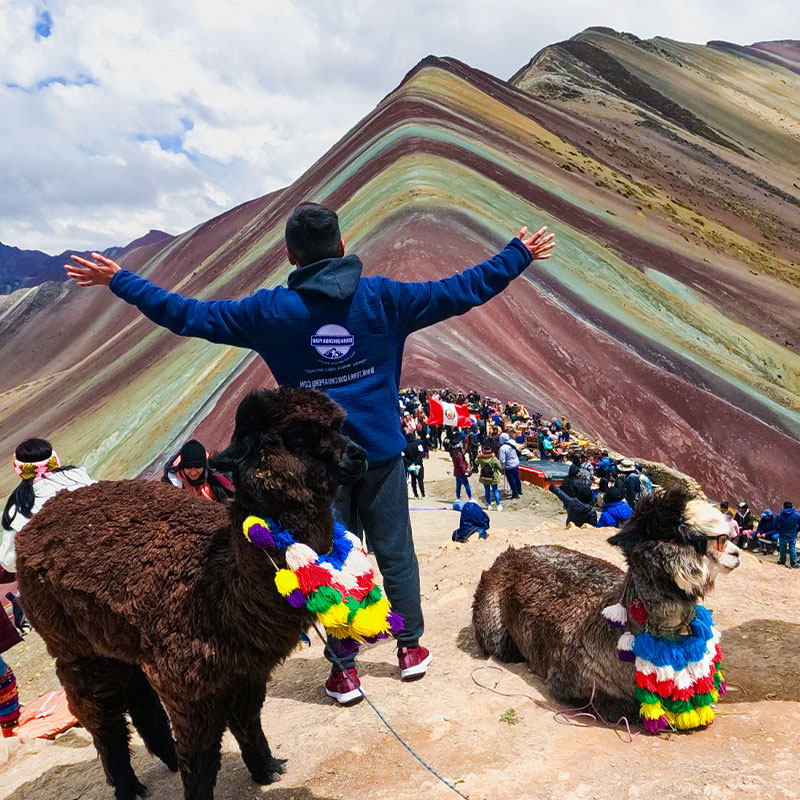
Vinicunca became famous around 2015–16, after the snow that used to cover it had melted away. Today it is one of the most visited sites in the Cusco region. The walk is short but steep for the altitude, and the last stretch to the viewpoint is the hardest part of the day. Horses can be hired for most of the way up, and the ATV version replaces part of the approach.
Two things most guides don’t tell you. First, the viewpoint is busiest from about 9 to 11 am, which is why good tours leave Cusco between 3:30 and 4:30 am. Second, access is managed by the local communities, not by a national authority. The site was closed from late 2023 to mid-2024 because of disputes between communities, fees were raised in August 2024, and collection arrangements changed again in 2026. We confirm access before every departure, but it is worth knowing that conditions on the ground can change.
Palcoyo: the easy alternative
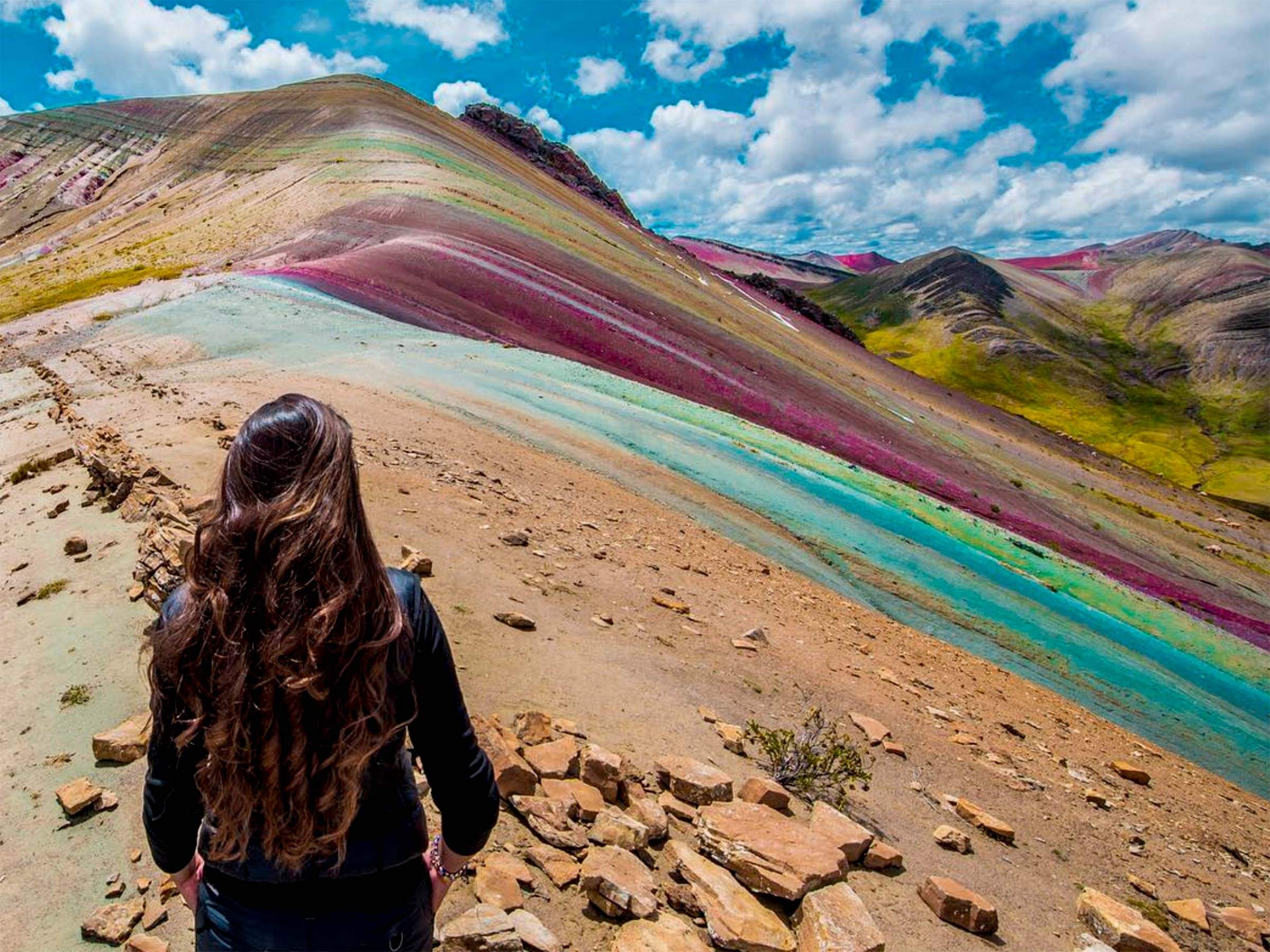
Palcoyo sits in the Checacupe district, near Ausangate. Its big advantage is the walk: about 3–4 km round trip with little climbing, on a gentle path from a car park that is already high. From the viewpoint you see three coloured ridges at the same time, and a ten-minute detour takes you to a “stone forest” of rock spires shaped by the wind. It is the best choice if you only arrived in Cusco a day or two ago, if you are travelling with older relatives, or if you simply want colours without a hard hike.
Don’t underestimate it, though. The summit is still close to 4,900 m, so walk slowly and drink water. Our Palcoyo tour includes the community entrance.
Pallay Punchu: the new one
Pallay Punchu is in the Layo district, Canas province, above the Langui-Layo lagoon. A local resident found the view in April 2020, during the lockdown, and his photos spread quickly; tourism grew from 2021. Its name means “decorated poncho” in Quechua, and it looks nothing like Vinicunca: instead of rounded stripes you get sharp, tilted ridges in red, ochre and green, like the teeth of a saw.
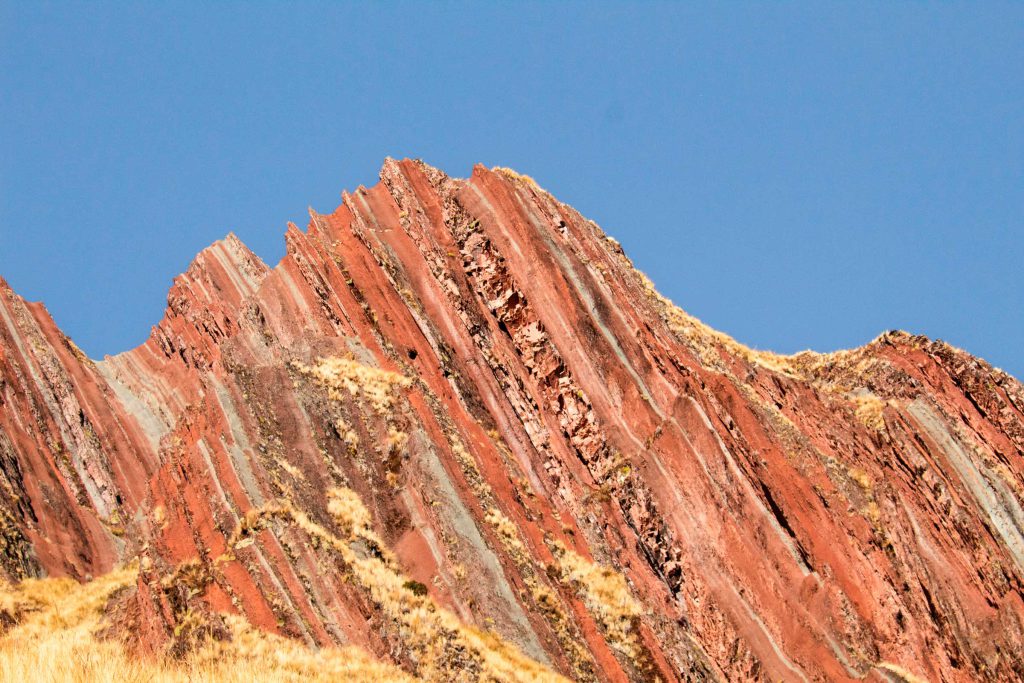
The trade-off is distance: it is the longest drive of the three, about four hours each way. The hike to the main viewpoint is short, and a longer walk along the ridge is possible when the weather is good. It is also the coldest and windiest in the afternoon, so read our weather notes on the Pallay Punchu tour page.
Which one fits you?
- “I arrived in Cusco yesterday” → Palcoyo, or better still, wait: do the Sacred Valley first and a rainbow mountain on day three or later.
- “I want the photo everyone knows” → Vinicunca, leaving before dawn.
- “I hate crowds” → Palcoyo or Pallay Punchu.
- “I’m a photographer” → Pallay Punchu for shapes and light, Palcoyo for the three-ridge panorama.
- “I’m travelling with kids or grandparents” → Palcoyo.
- “I want a real hike” → Vinicunca, or the multi-day Ausangate treks that reach it from the back.
When to go
May to October is dry, with the clearest skies and the most intense colours after the sun is up. Nights and early mornings are below freezing. From December to March, clouds, hail and even snow can hide the colours or make the paths muddy; tours still run, but visibility is a gamble. In any month, bring layers, gloves, a hat, sunscreen and sunglasses — the sun at 5,000 m is strong even when the air is cold.
Altitude: the part that really decides your day
All three go well above Cusco’s 3,400 m. Plan them for your third day in the region or later, eat a light breakfast, walk slowly and tell your guide if you have a strong headache, nausea or dizziness. Our guides carry oxygen and first aid, but the best prevention is time. If you are also hiking to Machu Picchu, a rainbow mountain makes a good acclimatization test before the Inca Trail — just leave a rest day between them. See all our Cusco day tours compared by altitude and effort.
Frequently asked questions
Which rainbow mountain is easiest?
Is Palcoyo as beautiful as Rainbow Mountain?
How high is Rainbow Mountain really?
Can I visit two rainbow mountains in one day?
Is Pallay Punchu worth the long drive?
Are entrance fees included in the tours?
About the author
Raquel Sánchez co-founded Terra Quechua Peru in Cusco in 2012 together with Edwin Medina, both with extensive trekking experience. She writes our Inca Trail guides from the day-to-day work of securing permits and organizing every departure with our guides, cooks and porters.