
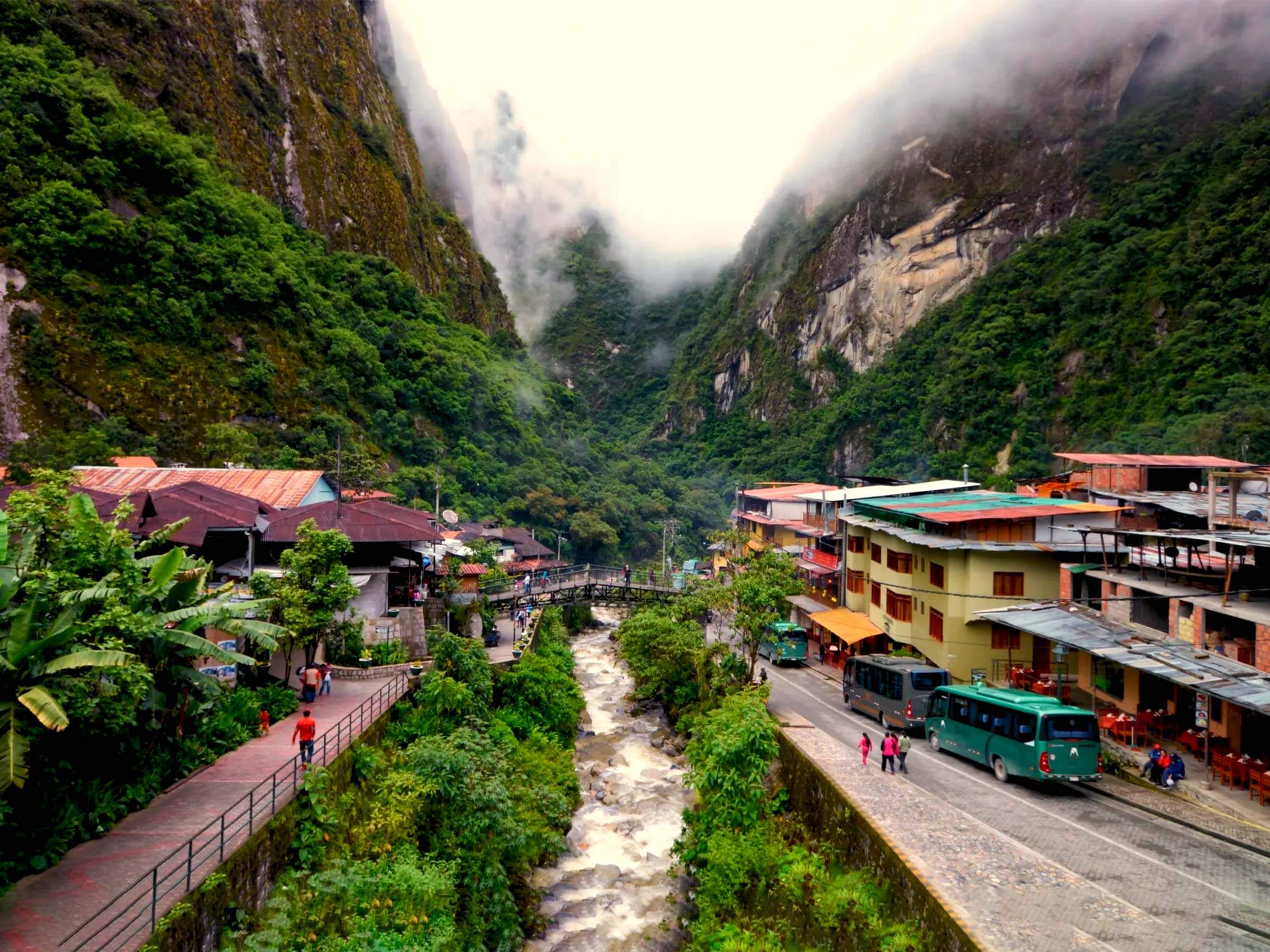
Aguas Calientes, officially Machu Picchu Pueblo, is the small town at the foot of Machu Picchu, on the Urubamba (Vilcanota) river at about 2,040 m (6,690 ft). There is no road into town: you arrive by train or on foot, and from here Consettur buses climb to the citadel in about 25 minutes, or you can walk up in about an hour and a half. Spend a night if you want an early entry slot or Huayna Picchu; if you only have one day, a day trip from Cusco still works.
- ≈2,040 m(6,690 ft): the town, about 1,360 m lower than Cusco and about 390 m below the citadel.
- ≈25 minby Consettur bus up the zigzag road to the Machu Picchu entrance; the first bus leaves around 5:30 a.m.
- ≈1 h 30on foot up a steep path of stone steps, if you prefer to walk.
What and where is Aguas Calientes?
According to Wikipedia’s entry on the town, Machu Picchu Pueblo is the seat of the Machupicchu district, in the Urubamba province of the Cusco region, and had 4,525 inhabitants in the 2017 census. Its old name, Aguas Calientes (“hot waters”), comes from the natural hot springs above the town. It grew as a camp for the railway workers, and tourism followed once the line was completed in 1931. The same entry puts the archaeological site about 6 km (3.7 mi) away.
Today the town lives from Machu Picchu visitors: the train station, hotels, restaurants, the bus stop and a craft market, all within walking distance in a narrow, green canyon of the Urubamba. At about 2,040 m it is the lowest stop on a normal Cusco–Machu Picchu trip, roughly 1,360 m (4,460 ft) below Cusco, and many people sleep better here. Every stop in meters and feet is in our Machu Picchu elevation guide.
How to get to Aguas Calientes: the short version
There are three ways in, and none of them is by car all the way. The details, timetables and luggage rules are in our Machu Picchu train guide, and every route from Cusco, including the treks, is compared on our Machu Picchu page. In short:
| Route | How it works | Time |
|---|---|---|
| Train from Ollantaytambo | Road from Cusco to Ollantaytambo, in the Sacred Valley, then train along the Urubamba | ≈2 h by road + ≈1 h 30 by train |
| Train from Cusco (seasonal) | Direct trains from the Cusco area run only part of the year, usually not from about January to April | ≈3 h 15 or more |
| Road via Hidroeléctrica | Drive via Santa Teresa to Hidroeléctrica (1,890 m), then walk along the tracks or take a short train | ≈6 h by road + ≈2 h 30 walking (or ≈45 min by train) |
| On foot | The Inca Trail ends at the citadel; Salkantay and other treks end in town | 1–5 days |
Times from the May–December 2026 rail timetable and our tour pages, as summarized in our Machu Picchu train guide. Schedules change: we confirm yours when we book.
Whichever way you come, pack light: the trains allow one backpack of up to 8 kg per passenger, so most travelers leave their suitcase in Cusco and bring only a daypack for the night.
The bus from Aguas Calientes to Machu Picchu, or the walk up
Consettur runs the buses between the town and the citadel. They climb the zigzag Hiram Bingham road from the bus stop in town to the entrance in about 25 minutes, the time we plan on our itineraries. They do not run to a fixed timetable: they leave as they fill, starting with the first bus at around 5:30 a.m., and the last buses down run in the late afternoon.
- TicketsYou buy the bus ticket in Aguas Calientes, not with the train or the entrance. On our three Machu Picchu tours the bus up and down is already included.
- FareConsettur sets its own price. We could not find a current, dated official fare, so we do not quote one here: check it at the ticket office in town before you travel.
- The queueEarly in the morning the line at the bus stop can be long. Your Machu Picchu ticket allows only 30 minutes of tolerance after your entry time (Ministerial Resolution 000508-2023-MC of the Ministry of Culture), so join the queue well before your slot.
Prices, circuits and sale dates for the entrance itself are in our guide to Machu Picchu tickets; the bus ticket does not get you into the site.
Walking up instead. If you would rather start the day on your feet, a footpath of steep stone steps climbs from the valley floor to the entrance. Our guides plan about an hour and a half up. It is a real workout, straight up the hillside the bus road zigzags across. Leave town with a headlamp if you walk before dawn, carry water and rain gear, and remember that you still need your entrance ticket and entry time at the gate.
Things to do in Aguas Calientes
Aguas Calientes is a base rather than a destination, but a free afternoon fills easily.
- Hot springsThe baths that gave the town its name are about 10 minutes’ walk from the center. Entry costs about S/15–20, paid in cash in soles. Bring a swimsuit; towels can be rented in town.
- Manuel Chávez Ballón site museumRun by the Ministry of Culture, it explains the excavations of Machu Picchu and how the Incas built it, and has a botanical garden behind it. The Ministry’s Cusco office lists it as open every day from 9:00 to 17:00, at S/22 for adults, S/11 for students and free for children. It stands at Puente Ruinas, about 2 km from town: walk about 30 minutes downriver along the road, cross the bridge over the Urubamba and turn right.
- The craft marketStalls of textiles, ceramics and souvenirs, easy to browse while you wait for your train.
- A proper mealIf you arrive on foot, the first restaurant meal after days of trail food is a highlight. On our treks, lunch on the last day is on your own, so bring soles or a card.
Should you stay in Aguas Calientes or go back to Cusco the same day?
Both work, and the choice depends on how much time you have. A day trip from Cusco is a long day: you leave before dawn, spend about 2 hours inside the site and are back in the evening. A night in Aguas Calientes turns Machu Picchu into a calmer morning visit.
| Night in Aguas Calientes | Same-day trip from Cusco | |
|---|---|---|
| Entry time | Early: our 2-day itineraries take the bus at about 5:30 a.m. and enter at 6:00 or 7:00, depending on the slots available | Late morning or midday, after the train arrives |
| Huayna Picchu | Easier to fit: a separate route with its own entry time (US$80 extra with us, subject to availability) | Possible only if the times line up |
| Pace | Train in the afternoon, visit the next morning, free time in town | Hotel pickup in the early morning and back in the evening |
| Where you sleep | At about 2,040 m, below Cusco | In Cusco, at about 3,400 m |
| Our options | Machu Picchu by car (from US$150) or Sacred Valley + Machu Picchu (from US$395) | Full Day by train (from US$295) |
Prices per person from our tour pages.
An early slot means fewer people on the bus queue and inside the citadel, and it leaves room to match the train with your entry time: we recommend at least 1.5 to 2 hours between the train’s arrival and your ticket time. If you are thinking about Huayna Picchu, read our section-by-section guide to the Huayna Picchu “Stairs of Death” before you choose.
Our Sacred Valley tour with the Machu Picchu connection, from US$395, visits the valley on day 1, takes the afternoon train and includes a hotel night in Aguas Calientes before an early visit. The budget option is Machu Picchu by car in 2 days, from US$150, with the road to Hidroeléctrica, the walk into town, dinner, the hotel night and the entrance. With no night away from Cusco, there is the Machu Picchu day trip by train, from US$295. The trip back after your visit, step by step, is in our guide to getting back from Machu Picchu.
Weather, rain and the river
Being lower and on the edge of the Amazon slope, Aguas Calientes feels warmer and more humid than Cusco, though nights are still cool enough for a sweater. Rain can come at any time of year. In the Cusco region the rainy season runs from about November to April, with the heaviest rain usually from January to March, and that is when the town is wettest and the paths most slippery. Rain, crowds and tickets month by month are in our guide to the best time to visit Machu Picchu.
Heavy rain occasionally brings mudslides (huaicos) down the side streams. The last major one reported by Peru’s state news agency Andina was on January 22, 2022, when the Alcamayo (also spelled Alccamayo) overflowed into town: two railway bridges and two footbridges were damaged and the station area was flooded, while the sector’s emergency operations center reported that the citadel and the Inca Trail network were not affected, and that the site would keep receiving visitors once rail service resumed. In the rainy months keep your plans a little flexible, follow the instructions of local authorities and your guide, and if something changes we rebook your train and entry with you.
What to bring for a night in Aguas Calientes
- A daypack, not a suitcaseThe train limit is about 8 kg per passenger, and inside Machu Picchu bags are limited to 40 × 35 × 20 cm (about 16 × 14 × 8 in).
- Your original passportYou need it with your Machu Picchu ticket at the entrance; students also bring their ISIC card.
- Rain gear and layersA rain jacket or poncho, a sweater for the evening and quick-drying clothes.
- Sunscreen and insect repellentThe sun is strong, and our tour pages list repellent among the things to bring.
- Swimsuit and cash in solesFor the hot springs, meals and small purchases in town.
- A reusable water bottleSingle-use plastic bottles are not allowed in Machu Picchu.
Plan your night in Aguas Calientes in five steps
- Secure your entry time firstMachu Picchu tickets are sold by circuit and time slot. Choose an early slot if you are sleeping in town.
- Book the train around itAn afternoon train the day before gives you time for the hot springs or the museum.
- Pack for 8 kgLeave your suitcase in Cusco and travel with a daypack.
- Be at the bus stop earlyThe first bus leaves around 5:30 a.m.; join the queue well before your slot.
- Plan the way backLeave a margin between your exit, the bus down and your return train.
Frequently asked questions
Is Aguas Calientes the same as Machu Picchu Pueblo?
What is the altitude of Aguas Calientes?
Can you drive to Aguas Calientes?
How long is the bus from Aguas Calientes to Machu Picchu?
Can you walk from Aguas Calientes to Machu Picchu?
How much are the Aguas Calientes hot springs?
Is it worth staying a night in Aguas Calientes?
Is Aguas Calientes safe in the rainy season?

About the author
Raquel Sánchez co-founded Terra Quechua Peru in Cusco in 2012 together with Edwin Medina, both with extensive trekking experience. She writes our Inca Trail guides from the day-to-day work of securing permits and organizing every departure with our guides, cooks and porters.